
Search
31 Desember 2025
Government expands food and feed reserves as stock targets rise for 2026The government is strengthening national food and animal feed reserves managed by state-owned enterprises, focusing on strategic commodities such as rice, cooking oil, and corn feed, as well as other food items that remain highly dependent on imports and prone to price volatility.
However, authorities have emphasized that distribution channels ‒ particularly for rice ‒ must be expanded to prevent quality deterioration that could lead to disposal and potential state losses.
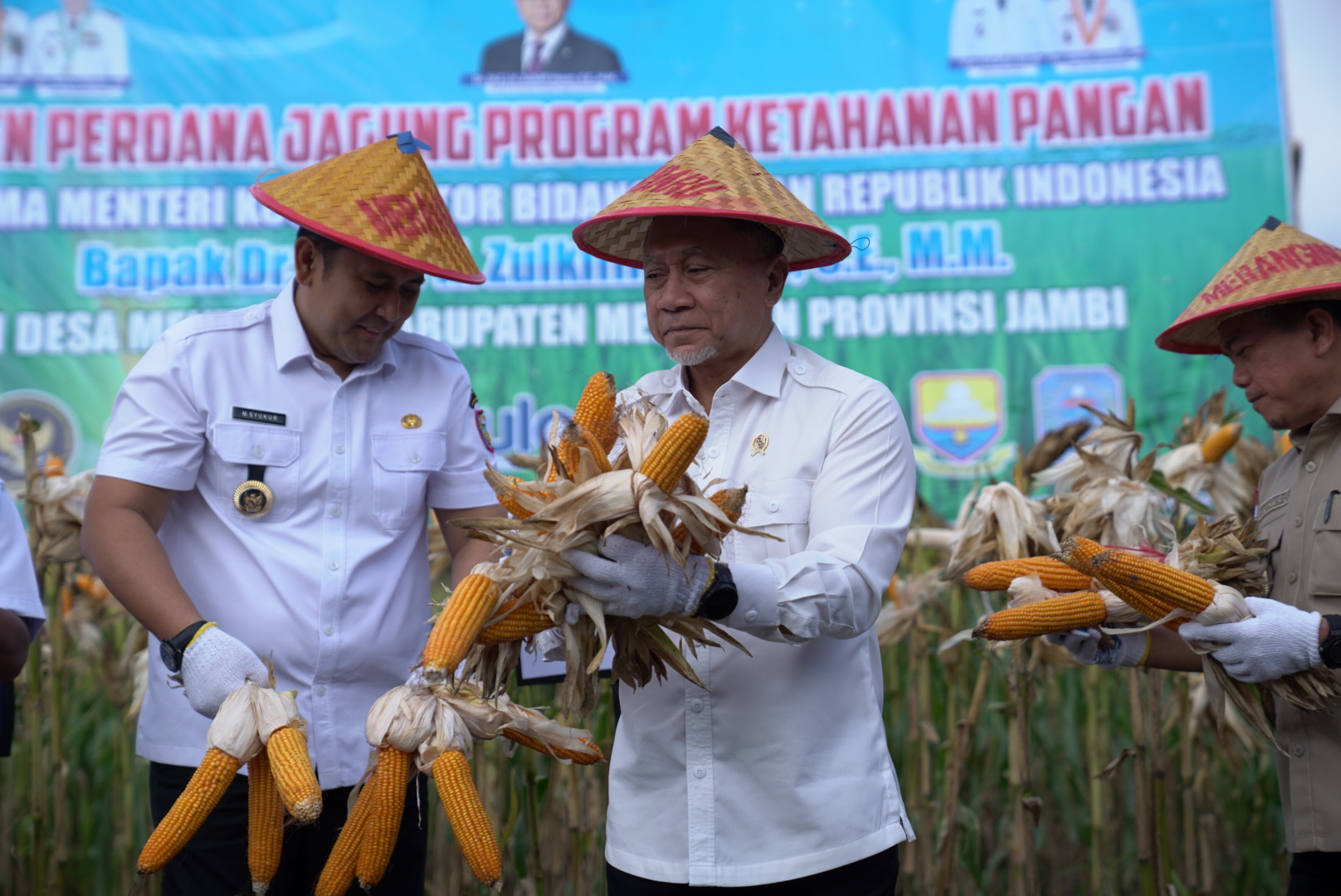
On Monday, December 29, 2025, the Coordinating Ministry for Food Affairs set the Government Rice Reserve (CBP) target for 2026 at 4 million tons, up from 3 million tons in 2025. Meanwhile, the Government Corn Reserve (CJP) is projected to reach 1 million tons in 2026, a significant increase from 300,000 tons this year.
Coordinating Minister for Food Affairs, Zulkifli Hasan, said the higher rice reserve target is intended to anticipate fluctuations in rice supply and prices, as well as to support food assistance programs, social safety nets, and disaster response.
“The rice and corn reserves will be sourced from domestic absorption. Bulog [State logistics agency] has been instructed to prepare procurement and storage facilities accordingly,” Zulkifli said on Monday as quoted by Kompas.id.
The government also plans to expand corn reserves to mitigate volatility in poultry feed prices. Demand for chicken meat and eggs is expected to rise in 2026 in line with the expansion of the Free Nutritious Meals (MBG) program.
Minister of Agriculture and Head of the National Food Agency (Bapanas), Andi Amran Sulaiman, said that the government aims to absorb 2–2.5 million tons of farmers’ unhusked rice, equivalent to milled rice, during the 2026 main harvest. The policy is intended to strengthen rice reserves while ensuring farmer prices remain profitable.
As of December 29, 2025, government rice reserves managed by Bulog stood at 3.39 million tons, the highest level since Indonesia’s independence.
“This is the largest government rice stockpile in history. For 2026, rice supply is not just secure ‒ it is very secure,” Amran said in a statement on Monday as quoted by Kompas.id.
In addition to rice, the government will also increase corn absorption to reinforce the corn reserve and stabilize farmer prices. The Ministry of Agriculture projects national production in 2026 to reach 34.77 million tons of rice and 18 million tons of corn.
Data from Statistics Indonesia (BPS) estimate rice production in 2025 at 34.77 million tons, while national dried corn output is projected at 16.55 million tons.
From a fiscal and infrastructure standpoint, the government plans to allocate Rp22.7 trillion (US1.6 billion) to Bulog through the 2026 state budget, alongside Rp5 trillion to construct 100 new Bulog warehouses.
Despite strong funding and storage capacity, maintaining rice quality remains a key challenge, as rice typically has a storage life of only four to six months. Experts have warned of potential disposal risks due to declining quality.
IPB University agricultural economist Dwi Andreas Santosa estimates that 100,000 tons of Bulog rice could become unfit for consumption, potentially causing Rp1.2 trillion in state losses. Meanwhile, Ombudsman Indonesia member Yeka Hendra Fatika projects up to 300,000 tons could face disposal risks, with losses reaching Rp4 trillion.
Bapanas has acknowledged that as of early October 2025, 29,990 tons of Bulog rice had experienced quality deterioration, consisting of both domestically procured and imported rice. Additionally, 1.45 million tons of imported rice, or nearly 38 percent of total reserves, had been stored for more than six months.
To mitigate quality risks, authorities are urging broader distribution channels for rice reserves. Currently, distribution is limited to programs such as Food Supply and Price Stabilization (SPHP), food assistance, and disaster relief.
However, Presidential Instruction No. 6/2025 allows rice reserves to be distributed to civil servants, the military, police, the MBG program, regional government reserves, and international cooperation or aid, as well as for export under certain conditions.
Beyond rice and corn, the government is also reinforcing the Government Cooking Oil Reserve (CMGP) managed by Bulog and State-owned food holding company ID Food. Under Trade Ministry Regulation No. 43/2025, exporters of palm oil derivative products are now required to allocate 35 percent of their domestic market obligation (DMO) for Minyakita [State-promoted low-priced cooking oil brand] to state-owned enterprises.
Director of Domestic Trade Development at the Trade Ministry, Nawandaru Dwi Putra, noted that Minyakita stocks at state-owned enterprises have increased over the past four months, partly due to cooking oil distribution under food aid programs.
Between September 1 and December 29, 2025, total Minyakita DMO realization reached 659,577 tons, with 116,949 tons, or 17.8 percent, delivered to Bulog and ID Food. Under the new regulation, deliveries to state-owned enterprises are expected to rise to 35 percent.
The government is also formulating strategies to stabilize garlic supplies and prices, given Indonesia’s heavy reliance on imports. Measures under discussion include distributing imported garlic to traditional markets, strengthening mandatory planting requirements for importers, and establishing government garlic reserves sourced from domestic cultivation.
